
Research & Development
Research & Development
Implementation of the R&D program of the BACFLY platform
R&D : Our collaborations
« From Research to Therapeutics »
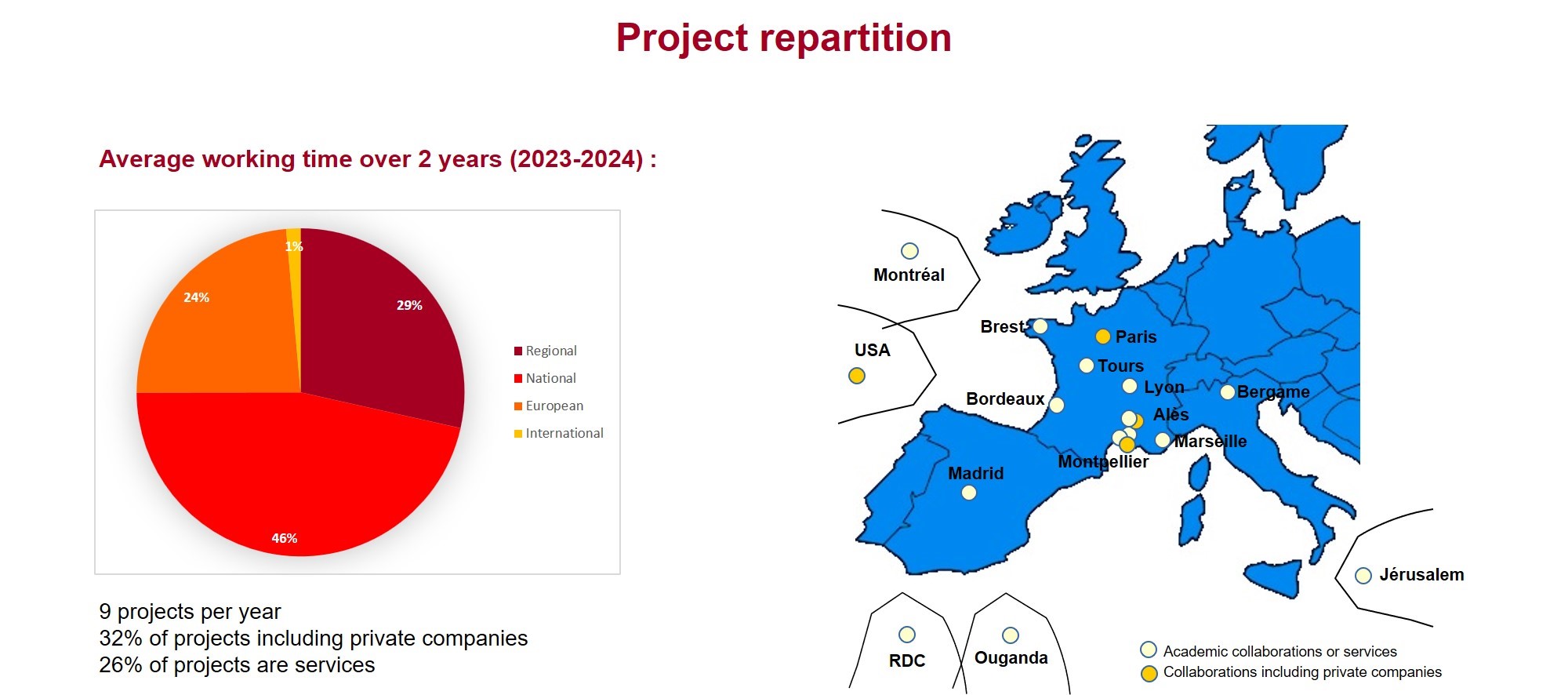
BACFLY aims to establish research collaborations (ANR, European contracts, etc.) with academic or private laboratories to promote the research and development of new therapeutic proteins. To facilitate the research-to-industry transfer, the technologies take into account industrial constraints as well as the recommendations from various health authorities.
Proof of Concept
The baculovirus / insect cell system is very straightforward for generating a series of mutants of a given molecule and identifying the most effective, best-produced, and most stable form. We have demonstrated with a very large panel of recombinant proteins that the properties observed with proteins expressed in insect cells were identical to those described for the natural protein.
Transfer to a Mammalian Expression System
Furthermore, if production in CHO cells is required for the industrialization process, the results obtained with the recombinant protein produced in insect cells are fully transferable to proteins produced in mammalian cells. However, there is one exception for recombinant antibodies, which show better ADCC when produced in insect cells, as the level of fucose on the Fc domain is lower.
Currently, our “Baculovirus and Therapy” team is part of the “Labex” MAbImprove project, which brings together several academic laboratories, physicians, and researchers for the discovery and optimization of therapeutic antibodies.
LabEx MAbImprove
The LabEx MAbImprove is led by Professor Hervé Watier (coordinator, Tours) and Dr. Pierre Martineau (deputy coordinator, Montpellier), and brings together 25 research teams from the University François Rabelais of Tours, the University of Montpellier, CNRS, Inserm, and INRA.

R&D : Internal projects
FlexiBac Secnull
The baculovirus/insect cell system is very promising for vaccine production. Some vaccines targeting viral diseases have already been approved by the FDA and EMA. These preparations typically consist of one or more soluble components of the viral capsid. A new generation of vaccines is being developed based on the construction of Virus-Like Particles (VLPs), which are viral capsids devoid of viral genomes. These VLPs have the advantage of inducing both humoral and cellular immune responses, even in the absence of an adjuvant.
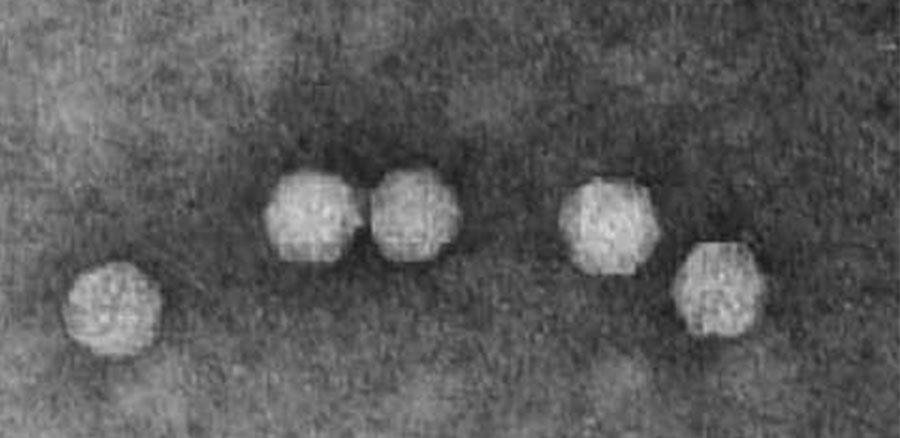
Electron microscopy observation of recombinant VLPs secreted by cells infected with a recombinant virus
The FlexiBac technology is the system of choice for producing such structures as it allows for:
- Co-expression of multiple proteins (all the components needed to generate stable VLPs).
- Modulation of the expression of all genes of interest using different promoters with various expression profiles (early and/or late promoters, and promoters with varying levels of activity) (correct stoichiometry of the different VLP components).
- Optimization of post-translational modifications such as N-glycosylation or enzymatic proteolysis.
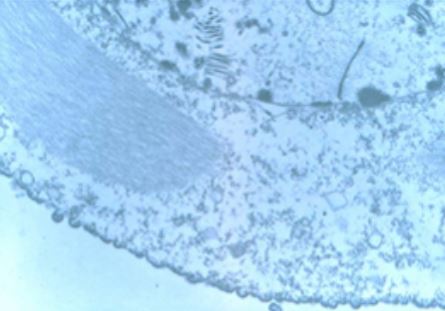 Electron microscope image showing the secretion of recombinant VLPs by an insect cell
However, this system has a major drawback : the co-secretion of VLPs and baculoviruses, which significantly complicates their purification.
To address this issue, we have developed a new approach derived from our FlexiBac technology, the FlexiBac Secnull system. This new system allows for the production of VLPs in the baculovirus/insect cell system while preventing the secretion of baculovirus particles.
The FlexiBac Secnull project received a CNRS pre-maturation funding in 2021 (operational and 18-month postdoctoral contract) as part of the SARS-CoV-2 VLP production.
FlexiBac Display
The objective of this project is to express a full-length human antibody on the surface of viral particles to isolate new antibodies or identify new targets.
A baculovirus-antibody library is currently under development.
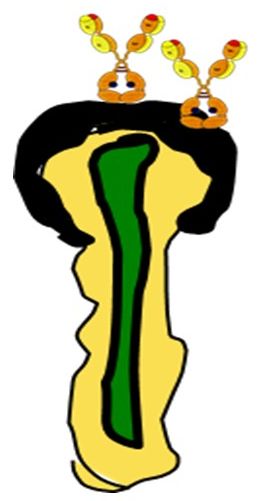 Recombinant baculovirus displaying full-length human antibodies on its surfaces

